

Emotional Wellness
There’s a Japanese word that keeps coming back to me. If you’re navigating retirement and searching for your reason to get up in the morning, it might be the most useful idea you haven’t heard yet. Nobody prepares us for finding purpose after work ends — and ikigai is the closest thing I’ve found to a map.
It doesn’t translate neatly. The nearest we get is “reason for being,” but that feels too grand for what ikigai actually describes. It’s subtler. More personal. It’s that feeling when you’re doing something and time disappears — when you forget to check your phone, two hours have gone, and you feel, somehow, more yourself than before.
That feeling. That’s the one.
The four questions
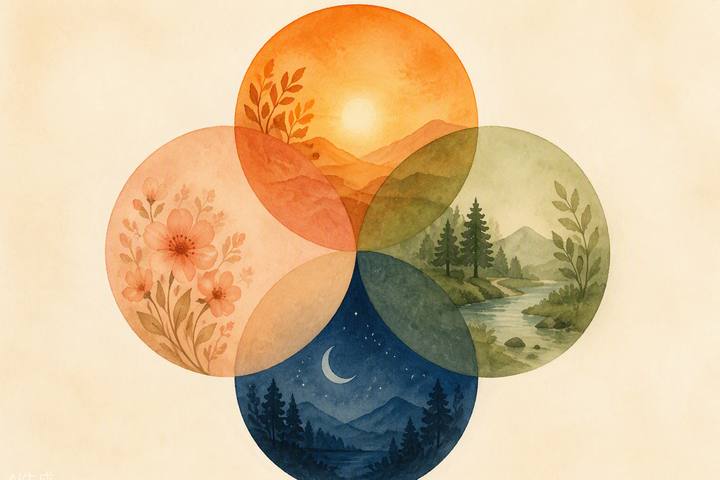
Ikigai is usually drawn as four overlapping circles, built from four questions: What do I love? What am I good at? What does the world need? What can I be paid for? The sweet spot where all four meet is supposed to be your purpose. Your joy.
I’ve seen that diagram a hundred times, and for years it only made me feel inadequate — as if everyone else had been handed private instructions I’d missed.
Ikigai isn’t something you find, like keys you’ve misplaced. It’s something you stumble toward — often sideways, often only recognised after the fact.
The map, I’ve come to believe, comes with you — but it only becomes readable once you’ve already walked a stretch of the path. That, strangely, was more of a relief than the diagram ever was.
The thing I didn’t know about myself
I spent many years running a manufacturing concern. I was competent at it. If you’d asked me then what my purpose was, I’d have said something about responsibility — the people who depended on the operation, the commitments I kept. All true. But not quite it.
What I didn’t yet know was that I was a writer. It came late, and without announcement. I began noticing I was composing sentences in my head as I moved through the day — reaching for words the way other people reach for tools. When I sat down to share something I’d read or wondered about, something settled in a way the work never quite managed.
That was the signal. I just wasn’t quiet enough to hear it. Retirement is what finally made me go quiet.
Retirement was my chrysalis
I think about the caterpillar. It doesn’t plan its transformation. It knows only this: do what you have to do — move, feed, grow — and then, when the time comes, go still.
That stillness, the chrysalis, looks like nothing from the outside. It looks like stopping. Like giving up, even. But inside, everything is reorganising. The caterpillar dissolves. Becomes formless. Before it becomes the butterfly.
Retirement was my chrysalis. The diary emptied. The urgencies fell away. The world went quiet, and something inside began shifting — slowly, without my permission or my plan.
I want to say this to anyone who needs to hear it: that slow dissolve is not failure. It is not stagnation. It is exactly what this stage looks like from the inside. Our culture celebrates the butterfly — the launch, the arrival — and has almost nothing to say about the formless middle. But that stage is real, and necessary. If you’re in it now, you may be exactly where you need to be.

The space
Viktor Frankl — psychiatrist, Holocaust survivor, one of the clearest writers on meaning I’ve ever read — wrote about the space between what happens to us and how we choose to respond. In that space, he said, lies our growth. Our freedom.
I think about that space often now. Because retirement hands us something we rarely had before: time. Time that is genuinely ours — not allocated in advance, not spoken for by the role or the schedule. Time that sits open in front of us and asks, quietly but persistently: what now?
For the first months, that question mildly terrified me. I filled the space with activity before it could ask anything of me. Slowly, I’ve been learning to let it ask — to sit with it without rushing to answer. And what I’m finding in that space is not a crisis. It’s a beginning.
If you’re still searching, I put together a free guide — a gentle place to start.
Get the Free Guide — The 5 Keys to Retirement Happiness →I won’t tell you what your ikigai is. By its nature it isn’t transferable — it’s the thing that is specifically, stubbornly yours. But it’s probably already stirring: in the thing you keep returning to, the conversation that makes an hour feel like ten minutes, the moment you lose yourself and just do.
What’s sitting at the centre of your four circles? I’d genuinely like to know — not the polished answer, the honest, unfinished one.
Stay awesome,
Farook
Take this with you
The Ikigai Map
One page to map what you love, what you are good at, and what the world still needs of you.
Download the free PDF →Stay a little longer
We did not come this far to coast
I wasn’t looking for Denzel Washington quotes. But a pinned page in Google Keep changed my afternoon — and reminded me why we didn’t come this far to coast.
The kettle question
“What still gets you out of bed in the morning?”
The comment box is just below — I read every one.
Leave a Reply