Joyful Living
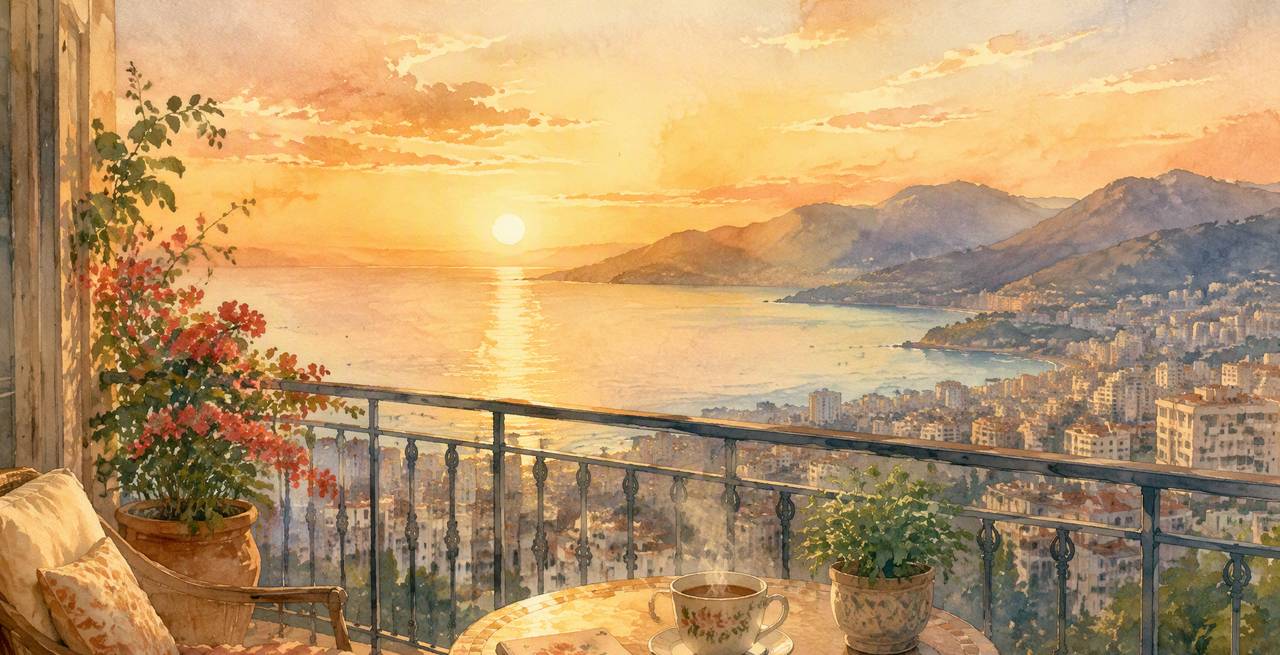
There is a photograph a friend took from our balcony a few years ago. Early light, the mountains in the distance holding the last of the dark, the sea catching the first of the colour. He posted it. The comments were what you would expect. Paradise. So lucky. Living the dream.
He was standing next to me when he took it. What the photograph does not show is that I had already been awake for an hour, and that the hour had not been effortless.
I have lived in Vung Tau, Vietnam for close to twenty years. I am sixty-nine. My wife Hau is here, and our poodle Bun Rieu, and a routine that would put most people to sleep just hearing about it. Friends fly in from Singapore, sit where that photograph was taken, and tell me I have won something.
I understand why they say it. From the outside, it is a very convincing picture.
But I have learned that the picture and the peace are two different things, and only one of them came with the apartment.
The morning nobody photographs
My day starts before five. Not by discipline anymore — by habit that has hardened into biology. The eyes open, the apartment is dark, and there is no argument to be had about it.
I wash up. I pray. I drink warm water. I stretch. I sit for meditation. Then I stretch again, because one round wakes the body up and the second round convinces it to cooperate.
Some mornings Hau wakes and puts on Louise Hay, and that soft voice moves through the rooms while I am on the floor working on hamstrings that have been quietly retiring since 1998. It is not a scene from anyone’s brochure.
A little after five the eastern sky begins. We are high up in the building. The mountains sit out there in the distance and this time of year the light climbs right over them — grey, then colour, then the whole morning at once.
Then the leash comes out and Bun Rieu remembers that he loves me. Forty-five minutes, to the park and back. Not the beach. The beach is six hundred metres from here and it belongs to weekends, when there is time to sit rather than move. Weekday mornings are the park: the exercise machines, the walking groups, the market waking up on the way home.
Then breakfast with Hau before she leaves for work. Some days I cook, some days she does. Then the door closes and the day is mine to do something with.
That is it. That is the whole famous life.
How I got here, which was not a plan
I did not design this.
I spent my working years in Singapore first — manufacturing, then leadership, forty years of it in total. Targets, shifts, people, problems that arrived faster than solutions. I was good at it, and I liked being good at it.
Then ten years in Malaysia. That was the crack in the wall. For the first time I saw a way of living that was not built entirely around urgency. Slower streets. Longer meals. People who worked hard and then, remarkably, stopped. I remember noticing it and filing it away without knowing what I was filing it for.
And then Vietnam happened. That is honestly the most accurate way I can put it. It was an opportunity, then a posting, then a life. Twenty years later, here we are.
If you had told the man in the Singapore office — the one with the calendar full of other people’s needs — that he would end up on a balcony above the South China Sea with a poodle named after a noodle soup, he would have laughed and then asked if it was going to affect the quarterly numbers.
I was, by the way, a friendly boss. I smiled easily. People told me they felt safe around me, and I have carried that as one of the few work compliments still worth anything to me now. But being warm with other people is not the same as being at peace inside yourself. It took me an embarrassingly long time to learn that those two can run on separate tracks.
What the visitors do not see
When my Singapore friends visit, they see the finished thing. Twenty years of it, compressed into a long weekend.
They see the view, the calm, the man in shorts at nine in the morning with nowhere to be. They do not see the stretch of time after I stopped working when the same view sat outside the same window and did absolutely nothing for me.
That is the part I did not expect. I had assumed the place would do the work. Beautiful surroundings, gentle pace, no more alarms — surely contentment is the automatic result.
It is not. The place is a setting. Whatever a man carries in with him, he carries in.
I had structure for forty years, and then I did not. I had a title, and then I did not. I had a hundred small daily proofs that I mattered — the phone, the meetings, the decisions — and then the phone got very quiet, very fast. Meanwhile the sun came up over the mountains every single morning, faithfully, indifferently, whether or not I was in any condition to appreciate it.
There is no push button on any of this. I looked for one.
Gratitude turned out to be a skill
I used to think gratitude was a feeling that visited good people. Now I think it is closer to a skill, and like most skills, I was bad at it before I was decent at it.
I was not raised to be grateful in any deliberate way. I was raised — and then trained by a career — to look at what was next and what was missing. That mindset builds things. It builds factories and teams and careers. It is a genuinely poor tool for enjoying an ordinary Thursday morning.
Learning it was awkward. Standing at the window and making myself actually look at the sky instead of glancing at it on the way to the kettle. Noticing the particular pleasure of warm water in the throat before the day has asked anything of me. Noticing that the dog is delighted, without conditions, about a walk he has done four thousand times.
None of that is profound. All of it had to be practised.
And contentment is its own separate work. Contentment means catching the mind wandering off — back to a meeting room in 2009, forward to some worry about next year — and walking it home again. Some mornings I do that once. Some mornings I do it before breakfast, and again after, and again on the walk.
That is not a failure of the practice. That is the practice. I stopped expecting it to be finished.
The two things holding it all up
Underneath the routine and the view, there are two things I count as the foundation.
Health is the first. I take it seriously now in a way my forty-year-old self would find slightly funny — the walking, the stretching, the sleep, the slightly higher cholesterol level which I am currently pretending to care about. But there is no version of this life that works without a body that will cooperate. Freedom without health is just a longer wait.
Hau is the second. She is why the whole thing has a heartbeat. She still goes out to work, which means our mornings have a shape and our breakfasts have a deadline. She plays Louise Hay when she thinks I need it and probably when she needs it too. A beautiful view with nobody to turn to and say look at that is only weather.
Twenty years of one house, one dog after another, one woman, one sunrise repeated seven thousand times. That is the actual asset. Not the postcode.
Peace is not a place you arrive at
I no longer think of peace as somewhere I got to. I think of it as something I make, most mornings, in the dark, before anyone is watching — and it does not stay made overnight. It has to be made again.
The prayers, the water, the stretches, the sitting, the walk, the breakfast with my wife: none of it is remarkable. If you filmed it, nobody would watch. But by the time the sun is properly over the mountains, I have already decided what kind of man is going to occupy this apartment today. On good mornings that decision takes ten seconds. On other mornings I make it three or four times before the kettle boils.
So when a friend on my balcony says I am living the dream, I say yes, and I mean it, and I also know the sentence is only half true. The view arrived. The peace did not. The peace was learned, badly at first, over years, and it still asks for something from me every day before dawn.
If you are somewhere beautiful and it has not fixed the feeling, I do not have a method for you. I only have what I know from the inside: the beauty is the setting, not the answer. The rest is something we make.
Mine gets made tomorrow at ten to five, whether I feel like it or not, with a poodle waiting by the door and a sky about to start over the mountains.
Most days, it is worth the trouble.
Keep well and enjoy the journey,
Farook
Take this with you
Three quiet minutes a day — noticing, breathing, arriving. The small practice this article runs on.
Download the free PDF →Stay a little longer
Ikigai — The Japanese Word I Wish I’d Known Before I Retired
There is a Japanese word that keeps coming back to me — and if you’re navigating retirement and searching for your reason to get up in the morning, it might be the most useful concept you…
The kettle question
“What’s the small thing you make every morning — the one nobody sees?”
The comment box is just below — I read every one.
Leave a Reply